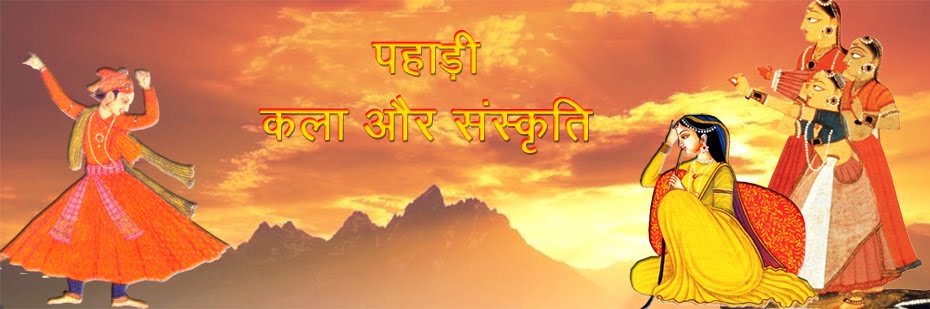
Kangra paintings belong to the school of Pahari paintings that were patronized by the Rajput rulers between the 17th and 19th centuries. This great art originated in a small hill state ‘Guler’ in the Lower Himalayas in the first half of the eighteenth century when a family of Kashmiri painters trained in Mughal Style of painting sought shelter at the court of Raja Dalip Singh (1695-1741) of Guler.
Kangra paintings is not a folk art, it is essentially aristocratic art, the patrons of which were the rulers of had fine sensibility and good taste, thus like the best of Europe, Kangra painting is the art of elite. This style was copied by the later Mughal painting, many of whom were patronized by the Rajput rulers who ruled various parts of the region.
The Kangra School became widely popular with the advent of Jayadev's Gita Govinda, of which many extant manuscripts feature exquisite Kangra illustrations. Though the main centre of Kangra paintings are Guler, Basohli, Chamba, Nurpur, Bilaspur and Kangra. Perhaps the most famous, or at least the most prolific school, was that of the Kangra School, from which came an extensive range of delicate and beautifully detailed paintings.
The Gita Govinda is a forest idyll and its Kangra paintings, the drama of loves of Radha and Krishna is played in the forest or along the river bank. In Kangra paintings, there is an art which celebrates life and love. The Kangra artists were hereditary painters who worked in the quiet of their cottages in the sylvan retreats of the Kangra valley.
The Kangra painters used colors made of vegetable and mineral extracts. Bhagvata Purana and the love poems Gita-Govinda of Jaidev were the most popular subjects dealing with the legends and the amorous plays of Radha and Krishna symbolizing soul’s devotion to God. Kangra painting presents a pure melody of flowing lines and glowing colors, breathing out a sense of space, tranquillity and poetic sentiment. Kangra paintings depict the feminine charm in a very graceful manner.
In the paintings of the Sat Sai the background of the architecture provides the setting for the love drama of Radha and Krishna. Bhakti cult was the driving force and the love story of Radha and Krishna was the main source of spiritual experience, which was also the base for the visual expression. Kangra paintings were influenced by the Bhagavad Purana.
Dharamshala International Film Festival 2014 is thrilled to host A Conversation with Rajat Kapoor, a session on acting, directing and more with the acclaimed filmmaker whose Ankhon Dekhi is Opening Night film this year. (3:30pm on November 1, 2014, at Club House Screening Room 2, Mcleodganj)
Rajat attended FTII and made his acting debut in the 1989 Kumar Shahani film, Khayal Gatha. His directorial debut was with Private Detective: Two Plus Two Plus One (1997). In 2003, he wrote and directed the independent film, Raghu Romeo, which won the National Film Award for Best Feature Film in Hindi.
How can people forget his Bheja Fry, which really fried the Bheja of most of us. Soak in the magic of cinema and learn from the best at a unique #filmfestival in the shadow of the majestic Dhauladhars. All those who wants to attend this session or watch the films can visit the film festival from 30 October to 2 November in TIPA, Mcleodganj, DHaramshala. You can see the complete schedule here : http://www.diff.co.in/
When we explore the picturesque locations of Himachal Pradesh, there lies another truth to world, the Cannabis farms. It has been already in news for years now. the upper Himachal region has been tagged as the largest Cannabis producer in India. The cannabis is production is illegal whether you produce it for your personal purpose or for earning profit.
Malana, in Kullu district which is the only place in India where people have their own centuries old civilization. Several documentary films have been made about Malana out of them two documentaries have won the national awards. Produced in 1999, 'Malana' directed by Himachal based filmmaker Vivek Mohan and 'BOM - One day ahead of democracy' directed by Amlan Dutta was produced in 2011. These films depicts the day to day life of the people of Malana. BOM is available in market and is easily available for viewers while there is no information about 'Malana'.
Now a feature film called 'M Cream' is ready to release in December 2014. As the name suggests and the film tailor reflects, the film is also based on Cannabis. If M stands for Malana, then off course this film will raise the questions on the production of Cannabis in Malana. This issue has already been very disturbing for Himachal Pradesh.
M Cream is an upcoming film directed by young independent filmmaker Agneya Singh. The film's cast and crew consists of actors and filmmakers from around the world. The film received best feature film award at the Rhode Island Film Festival in 2014. The film is scheduled to release in December, 2014. The film's cast includes Imaad Shah, Ira Dubey, Tom Alter, Barry John, Lushin Dubey, Auritra Ghosh.
How will this film explore Himachal or present it to world, that can only be told after the release of this film. But definitely there is one positive point Himachgal that it explores the picturesque locations of Himachal and present it to the world. We leave you with the film trailer :
How can we develop cinema in Himachal Pradesh if there is no cinema hall for the people to watch films? This is the question many filmmakers shoot in response to producing Pahari films. Off course they are not wrong but they are not right either. Cinema halls are for mainstream cinema and which have always been. They always play the mainstream films where millions or billions of rupees are spent to produce them. Being a less populated state, it's not easy to run a cinema hall in Himachal Pradesh. But the saying is that necessity is the mother of all. If we focus on producing the films for international audiences, the local audience will also come forward to watch the film.
Well filmmakers produce Pahari films or not, the businessmen build cinema halls or not, but the demand for cinema has already been increasing in Himachal. In response to that some people have started providing good cinema to the people over here. As of now, two film festivals are being organized in Himachal every year.
Shimla Film Festival was organized in the beginning of this year in Shimla which received an overwhelming response from local community as well as from the tourists. Although some of the delegates were not happy with the management and the judges decision but all this happens during the first time.
On the other hand Dharamshala International Film Festival was started in 2012 and is being organized this year for 3rd time subsequently. Dharamshala International Film Festival is a non-profit venture presented by White Crane Arts & Media, a trust set up by long-term Dharamshala residents and internationally renowned filmmakers, Ritu Sarin and Tenzing Sonam, to promote contemporary art, cinema and independent media practices in the Himalayan region.
Soon there are some other groups looking forward for the development of Cinema in Himachal and working on certain projects. Hopefully we will be able to see some good and meaningful cinema in Himachal soon.
Upcoming Festival
Dharamshala International Film Festival 2014
30 October - 2 November 2014
Venue : Tibetan Institute of Performing Arts (TIPA)
There is miles of distance between #HimachalPradesh and #Manipur but when it comes to geographic locations, both the states looks alike. That was the reason for #Omung Kumar, the director of #MarryKomMovie to chose Himachal as an alternate location for shooting his debut feature film. The communal tension the conflict between locals and armed forces is preventing the the #bollywood to stay away for north-eastern states of #India.
#MarryKomMovie was based on the life of the boxer M. C. Marry Kom, the five times world champion and mother of three kids. #PriyankaChopra very well played the role of Marry Kom in this movie. The film was shot in various places in #Manali, #Dharamshala and #Mcleodganj. The local #Tibetan crowd was used in the film to reflect the #Manipur.
M C Marry Kom, Indian Boxer, Five Times World Champion
Various actors in the film were from #TIPA (Tibetan Institute of Performing Arts), Dharamshala. This is not happened for the first time that any #bollywood film used Himachal locations to reflect some other places. In the recent times, due to the terror activities in #Kashmir, many bollywood films were shot in Himachal as a substitute to Kashmir. Most of these films are based on #IndianArmy such as #MaTujheSalaam, #TangoCharlie, etc.
It seems like, even in the coming years, many other film directors will come to #Himachal as the terror tension in Kashmir and North-East is still the same. Well these films do definitely add to the state's economy but the artist's in Himachal or the Himachali entertainment industry are not getting any profit from all these films. There is no specific agency or organization to look after the interests of #Pahari (Himachali) artist.
We hope in the coming years, some people would come forward for the development of a new cinematic culture in Himachal Pradesh.